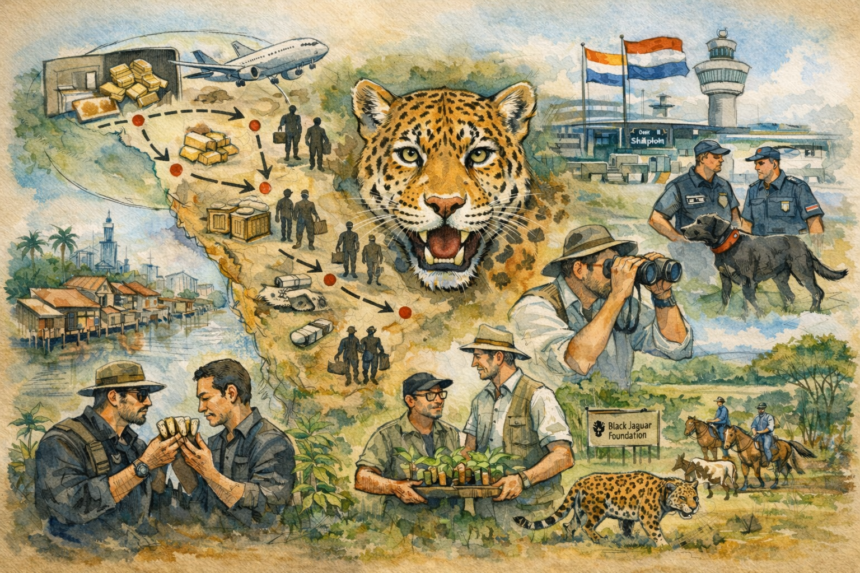
In the Surinamese Amazon, the Wayana people tell a story: a dying Jaguar King once crawled into their village, and a healer saved him by peeling away his diseased fur to reveal a human underneath—binding jaguar and human as family forever. Today, while the Wayana still see jaguars as ancestors, the modern world boils their bones into paste sold as medicine in Asia—and the Netherlands, a small country with no jungles of its own, realized it could only stop this by changing the economics of the jungle itself.
The Spies: Mapping the Shadow Routes of the Illegal Trade
Changing the math of the jungle started with a simple question: How does the illegal trade actually move? In 2019, a Dutch-funded consortium launched Operation Jaguar, deploying undercover agents who posed as traffickers across Suriname, Bolivia, Peru, and Ecuador. For example, pretending to buy jaguar fangs in Paramaribo’s bars. They mapped the criminal networks, set up anonymous tip lines, and trained local lawyers to build cases so strong that even corrupt judges couldn’t dismiss them.
By 2023, Operation Jaguar had identified 75 traffickers. The real discovery: jaguar parts move through the same routes as cocaine, illegal gold, and trafficked humans. This changed everything. Suddenly, jaguar conservation wasn’t just an environmental issue—it was organized crime. Justice ministries paid attention. Interior ministries sent resources. The jaguar became evidence in a larger battle.
The Trees: The Dutch Mission to Reforest 2,600 Kilometers
While undercover agents mapped trafficking networks, another Dutch mission began. In 2009, businessman Ben Valks traveled to the Amazon with a film crew to document a black jaguar. He didn’t find one. Instead, he found devastation: hundreds of kilometers of deforested land, rivers choked with sediment. The jaguar he wanted to film had nowhere left to walk.
Back in the Netherlands, Valks made a choice: not to film the devastation, but to fix it. He founded the Black Jaguar Foundation in Amsterdam and set an audacious goal—plant 1.7 billion trees to restore the 2,600-kilometer corridor connecting the Amazon to the Cerrado.

For years, Brazilian ranchers had ignored the Forest Code requiring them to keep 80% of their land as wild forest. Enforcement was weak, so they cleared it all for cattle. The Foundation changed the equation with a simple pitch: build a tree nursery on your ranch. We provide millions of saplings free, funded by the Dutch Postcode Lottery. We send experts. You follow the law. In return, you become a “sustainable partner” who can sell beef to Europe.
It’s starting to work. About 1 million trees were planted so far. Cattle ranches now double as tree nurseries. Farmer Marcos even built his own nursery when funds ran short. The Dutch partnership opens European markets. This is restoration capitalism—making conservation profitable.
The Data: Proving that Coexistence is More Profitable Than Conflict
However, the reality is that not every rancher wants trees. Many still see jaguars as threats to their core business: cattle. Before Dutch involvement, the story was simple—jaguars kill cattle, ranchers kill jaguars. Then WWF Netherlands funded research that changed everything.
The Pantaneira Jaguar Project asked: Can jaguars and cattle ranching coexist? Researchers tracked kills on ranches in Miranda and Corumbá. The data shocked everyone. Jaguars kill less than 2% of cattle. Cows are six times more likely to die from snakebite or disease. Many “kills” were just scavenging—jaguars eating animals already dead. When attacks did happen, the cause was clear: not enough wild prey. More capybaras and deer would lead to fewer dead cattle.
Conservationists brought the data to cattle industry leaders with a deal: let’s work as partners, not enemies. It was the first time, ranchers said, that NGOs treated them as collaborators instead of villains. The scientists proposed practical steps—pen calves at night, remove carcasses quickly, move pregnant cows from forest edges. They didn’t ask ranchers to love jaguars, just to manage the risk like they manage disease and fire. It was never about changing the heart, but about changing the math.
However, since then, some ranchers have even started to love the jaguar. Ranches that once paid for poison and bullets are discovering that they can earn more from tourists than from cattle—a live jaguar, a study found, is worth fifty times more than a dead cow.
Beyond Philanthropy: A New Blueprint for the Amazon
Jaguar Diplomacy works because it accepted a uncomfortable truth: in a world driven by profit, you can’t save what you can’t monetize. The Wayana healer didn’t save the Jaguar King with love—he used skill, knowledge, and a willingness to see kinship where others saw difference. Today, the Netherlands does the same, aligning survival with prosperity, treating ranchers as partners instead of villains. It’s not the world we might wish for, where jaguars survive simply because they deserve to. But for now, it’s the world we have—and in that world, making the jaguar valuable might buy us some time.