


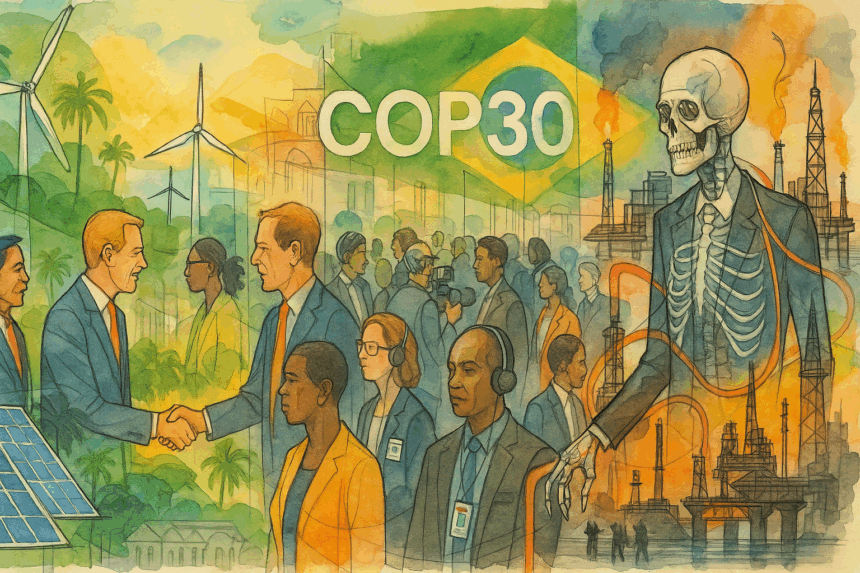
Belém feels like a hallucination. Not the rainforest dream that COP30’s brochures promise, but a humid, overwhelming, globally significant paradox: the world’s most important climate summit staged at the gateway of the Amazon, while hotel rooms go for thousands of dollars a night. A new BR-316 bypass road on the edge of Belém runs through a protected area and has become a flashpoint. If you ever wanted a physical metaphor for this era, Belém is it. Renewables are cheaper than ever, but fossil fuels are still walking the world like a zombie.
What struck me is that solar module prices have collapsed by around ninety percent in the past decade. Batteries are cheap. Almost half of all new Dutch cars plug in. There are many reasons to be optimistic. And yet global emissions continue to rise. Eighty percent of the world’s energy consumption still comes from fossil fuels. So as the Netherlands lands in Belém — with Dick Schoof shaking hands in the Amazon humidity, Dutch diplomats weaving between side events, and ministers trying to reassure Latin American partners that we haven’t slipped into climate complacency — one question hangs in the air: why is the fossil-fuel zombie still alive, and what will it take to kill it for good?
This COP was always going to be different. Brazil branded COP30 as the Implementation COP, the moment when the world finally shifts from making commitments to actually delivering on them. But the contradictions hit you fast. The more I look at this, the more it feels like Belém is bursting at the seams. Delegates from developing countries and Indigenous communities — the very people who need to be here most — are being priced out of the summit designed to protect their future. Some delegations are shrinking, and others have even considered withdrawing entirely. Austria’s president publicly cancelled his trip over hotel prices. Meanwhile, Brazil is launching the world’s most ambitious forest-finance scheme while also pursuing expanded offshore exploration plans near the Amazon River mouth. The two realities coexist comfortably within the same country, the same month, the same presidency. Brazil has every right to lift its people into prosperity, which is why Brasília frames its oil as a potential engine of a just transition. Yet, in reality, the profits feed growth and inequality, not structural change, stretching planetary boundaries and exposing the impossible contradiction at the heart of Brazil’s climate strategy.
At the centre of the action this year sits Brazil’s new Tropical Forest Forever Facility — the TFFF — a USD 125 billion experiment that tries to flip the logic of conservation. Instead of paying countries not to deforest, the world would now pay them for keeping forests standing. It is satellite-verified, performance-based, and open to more than seventy tropical nations. And, unlike most climate funds, it guarantees that twenty percent of all resources must go directly to Indigenous Peoples and Local Communities. Not “can”. Not “should”. Must. The Netherlands helped shape the fund and is contributing to the secretariat. If the TFFF works, it becomes the world’s first real financial firewall against ecological collapse. If it doesn’t, it becomes another bold idea swallowed by bureaucracy.
More Read

It seems to me that adaptation also takes centre stage in Belém this year. Scientists arrived with data so alarming it borders on surreal. In some Amazon lakes, water temperatures have already spiked to nearly 40°C — killing hundreds of river dolphins — while studies show that fish are now turning up with mercury and microplastics in many of the places scientists are sampling. Oxygen levels are collapsing, and fish larvae are developing deformities that make survival impossible. This isn’t a distant threat; it’s happening now. Brazil wants COP30 to transform adaptation from an abstract goal into a measurable, fundable global programme. Negotiators have spent the week racing to finalise the world’s first set of adaptation indicators — the metrics that would finally allow humanity to track, compare, and scale resilience. But without a dramatic increase in adaptation finance by wealthy nations, indicators will mean little. Measurement without money is just administration.
Moreover, this year, the financial tensions run deeper than ever. Developing countries are arriving in Belém with decades of broken promises in hand. The famous USD 100 billion pledge wasn’t met on time. Two-thirds of climate finance still arrives as loans, often at commercial rates. Public finance is expected to drop in the next two years. Against that backdrop, rich countries are urging developing economies to move faster. It’s an impossible ask without resources. The Baku to Belém Roadmap to 1.3T — the new plan to mobilise USD 1.3 trillion annually by 2035 — is supposed to rebuild trust. But if it relies too heavily on private finance, vulnerable nations see it for what it is: a politely phrased version of “you’re on your own.”
I can’t shake the sense that the Dutch delegation arrives with its own identity crisis. On one side is the Netherlands that prides itself on water diplomacy, adaptation leadership, EU climate ambition, and co-creation in Amazonian finance. On the other side is a country wrestling with domestic political turbulence, fossil-fuel subsidies, and the broader European anxiety that China is racing ahead in solar, wind, and batteries while the United States is drifting away from climate cooperation. COP30 forces the Netherlands to do more than negotiate; it forces it to decide what kind of climate actor it wants to be.

But the biggest story unfolding in Belém is the “grey world” paradox. Clean electricity is booming. The future is arriving faster than expected. Yet the world that clean energy powers — the cars, highways, global agriculture, aviation, steel, cement, plastics — still runs on fossil fuels. We’re electrifying everything without decarbonising anything. Cheap solar built the future. Fossil fuels built the world we live in. And we seem unwilling to let that older world die.
And hidden inside that paradox is a truth wealthy countries don’t like to say aloud: developing economies still depend on fossil fuels not out of denial, but because they are the only growth model that reliably pays. Oil and gas fund schools in Nigeria, keep food prices down in Egypt, and balance budgets in Indonesia. Asking these economies to leapfrog straight to clean energy without providing industrial policy, concessional finance, or market guarantees isn’t a transition. It’s a trap. And everyone in Belém knows it.
Maybe the uncomfortable truth is this: fossil fuels remain dominant because powerful institutions protect them. Oil and gas are backed by states, armies, trade flows, debt markets, and thirty years of sunk pipelines and ports. Solar has technology. Fossil fuels have political economy. One behaves like a market; the other behaves like a regime. Until countries confront that distinction, the planet will keep running a clean-energy operating system on a fossil-fuel machine.
COP30 won’t save the Amazon or magically realign global climate politics. But it will reveal something fundamental: whether multilateralism still works, whether developing economies still trust the developed ones, whether adaptation finally becomes a real economy, whether forests can be financially defended, whether fossil fuels meet a political limit, and whether the zombie economy driving planetary collapse can finally be confronted.
Because killing the zombie for good isn’t about moral clarity; it’s about institutional muscle. It means fossil-phaseout treaties with teeth. Grid upgrades on a wartime footing. Debt relief tied to climate commitments. Adaptation finance that’s automatic rather than negotiated. And a global industrial strategy that finally treats the Plural South as a partner rather than a recipient. Without these, courage is just a word in a speech.
The world has already plugged itself into the sun. Now it needs the courage to unplug from the flame. And Belém — messy, humid, contradictory Belém — is where that courage is being tested during COP30.


