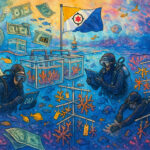
The World’s Hottest Cold War
It doesn’t make all the headlines, but it contains every ingredient of the next global conflict: oil, ideology, crime, and denial. Look at a map. Only forty miles of water separate Venezuela from Curaçao — a self-governing island that remains part of the Kingdom of the Netherlands.
A Regime on Life Support.
On one side lies Nicolás Maduro’s authoritarian regime — a collapsing state propped up by Chinese oil contracts, Russian weapon systems, and Iranian technicians, sitting atop the world’s largest proven oil reserves: more than 300 billion barrels. At current oil prices, those reserves are worth over $18 trillion.
Interdiction, or Just a Better Word for Invasion?
On the other side, the United States has built up its largest Caribbean presence since the 1989 invasion of Panama. The USS Gerald R. Ford — the world’s biggest nuclear-powered carrier — now looms in the region, bringing thousands of sailors and a deck full of strike aircraft. F-35s have been forward-deployed to Puerto Rico, joined by destroyers and a nuclear submarine. Several of those ships carry Tomahawk cruise missiles — useless for drug busts, but perfect for hitting land targets. Behind the scenes, senior U.S. commanders have now briefed Trump on a menu of strike options inside Venezuela — including land targets — a shift that signals intent even if no green light has been given publicly.
The Kingdom in the Crossfire
And in between drift the Caribbean territories of the Kingdom of the Netherlands — a speck of Europe anchored in the tropics, caught in a struggle it didn’t start and can’t control. It’s a postcard sitting on a tripwire.
The Donroe Doctrine: Make the Hemisphere Great Again
The Pentagon calls its new Caribbean deployment part of a “maximum pressure campaign.” One could call it the ‘Donroe Doctrine’ — a quiet revival of the Monroe Doctrine under Donald Trump, meant to push China, Russia, and Iran out of the Western Hemisphere. The Ford carrier group alone can launch 75 aircraft, each capable of striking targets deep inside South America. If China or Iran had built up such large capacity in the region, the world would call it war. When the U.S. does it near Venezuela, it’s called interdiction.

When ‘War on Drugs’ Stops Being a Metaphor
The U.S. now treats the region as a “theatre of counter-narcotics operations” — a sterile phrase for what can look a lot like war. Since early September, American forces have launched lethal strikes on suspected trafficking vessels, beginning with a mission that sank a boat off Venezuela and killed eleven people. Washington’s campaign is aimed less at street-level smugglers than at the Cartel de los Soles — Venezuelan officers accused of running cocaine routes — and the Tren de Aragua gang network whose tentacles now reach into the Caribbean.
Regime Change Is Back in Style
Allegations of drug carrying are rarely accompanied by public proof; the legal justification appears to rest on classified rules of engagement and legal opinions that effectively shield U.S. forces from prosecution in these strikes. What’s unfolding looks less like routine interdiction and more like a quietly expanding war-footprint. And it’s not just the Navy. For the first time in decades, a U.S. president said the quiet part out loud: the CIA is back in Venezuela. Trump, back in command of the American machine, has publicly confirmed authorizing CIA covert action. It is therefore not surprising that Colombia suspended intel-sharing over the strikes. What began as a drug war now looks like regime change. Secretary of State Marco Rubio and his circle were openly pushing for a military campaign to drive Maduro from power. The buildup, insiders said, was part readiness, part psychological warfare — meant, in one planner’s words, “to scare the pants off the Maduro regime.”
The Drug War as Alibi
The drug war has always served a political purpose: shifting blame outward. Even though most overdose deaths in the United States come from drugs made or trafficked internally, election cycles reliably resurrect the imagery of foreign supply. The Caribbean build-up fits that logic perfectly — a visible solution to a largely domestic crisis.
Mogadishu by Design
Meanwhile, Caracas is preparing for what it calls resistencia prolongada — prolonged resistance, a plan to booby-trap the capital and fight block by block if America invades. Venezuela knows it can’t win a conventional war, so it has learned to weaponise disorder.
Washington still carries the scar tissue of Mogadishu, Somalia. In 1993, American power collapsed in a matter of blocks — not because the U.S. lacked firepower, but because the city refused to behave like a battlefield. Mogadishu turned itself into terrain: alleys became choke points, rooftops became artillery, civilians became concealment. It was the first modern lesson in how an inferior force can dissolve a superior one by dragging it into an environment where nothing is linear and nothing is controllable.
That’s the logic Caracas is trying to bottle. The way a city can absorb an invader, disorient it, bleed it, and spit it out. It is actively putting in place a guerrilla-warfare contingency plan in anticipation of a possible U.S. air or ground assault. According to recent documents and sources cited by Reuters, Caracas intends to deploy small, dispersed units across more than 280 locations to conduct sabotage and irregular warfare. In practice, it’s an instruction manual for turning your own country into a trap. The plan even has a term — anarchización. Not collapse. Choreographed collapse. Venezuela isn’t copying Mogadishu; it’s studying how Mogadishu broke the United States — and preparing a version written in Spanish, concrete, and barrios verticales. The Nicolás Maduro government publicly called on the U.S. not to embark on an “Afghanistan-style forever war” in Latin America.
The Axis of Evasion
And the Venezuelan regime’s survival depends mostly on three patrons: China, Russia, and Iran. In mid-to-late 2025, roughly 80–90%+ of Venezuela’s oil exports flowed directly or indirectly to China, funnelling billions through barter and backchannels. Russia has delivered Buk-M2E missile batteries, Igla-S launchers, and air-defense radar systems capable of tracking U.S. jets. Iran, sanctioned into creativity, supplies condensate — the chemical lifeline that keeps Venezuela’s oil industry from seizing up — and engineers who repair refineries too toxic for Western contractors to touch.
Together, these patrons have built a parallel economy of evasion. Many shipments of Venezuelan crude to China are documented in Chinese customs as Malaysian origin or Malaysian bitumen-blend, often after a stop or trans-shipment in Malaysian waters, pointing to relabelling of the cargo’s true Venezuelan origin.
A European Kingdom, Tropical Problems
The Kingdom of the Netherlands insists it is not part of this confrontation. Yet its Caribbean territories sit at the heart of it. On Curaçao and Aruba, the United States operates surveillance flights and refueling missions. Officially, the flights are “unarmed,” the operations “temporary,” and the facilities “shared.” In practice, they anchor Washington’s presence in the region. The same islands that host American aircraft also sit astride the maritime routes used to move Venezuela’s oil, gold, and cocaine: the same commodities that keep Maduro’s regime alive and tie it to China, Russia, and Iran. Dutch officials describe this as a “regional security challenge.” But geography has made it something harder to define — quiet complicity. A European NATO ally hosting U.S. facilities on its Caribbean islands now finds its territory entangled in a global confrontation it no longer controls.
A Front Line by Geography, Not by Choice
Unlike the European Netherlands, the Caribbean territories fall outside NATO’s mutual defense guarantee — a gap that quietly exposes the Kingdom’s southern flank. If fighting or sanctions deepen Venezuela’s implosion, the Dutch Caribbean could see another wave of desperate arrivals, overwhelming local hospitals and police. Curaçao and Aruba already host 23,000 Venezuelans — with Aruba having the world’s highest per-capita refugee load. The Dutch Caribbean has become a front line without consent — a front line by geography, not by choice. In January, Caracas tightened restrictions on Dutch diplomats’ movements around the capital, limiting their travel and access. The Hague hit back within 48 hours. By July, it had issued a ‘Code Red’ — its first ever travel ban on Venezuela.”
Curaçao’s Prime Minister Gilmar Pisas has been unusually direct in recent months. He has acknowledged that because U.S. patrol flights operate from the island so close to the Venezuelan coast, Curaçao is inevitably pulled into the dispute, a position he has described as uncomfortable for the local government. He has also emphasized that all official contact with Washington must go through The Hague — Curaçao hosts the operations but does not control the diplomacy.
The Caribbean Is No Longer Background Noise
Earlier this year, the Hague insisted there was “no immediate threat.” Yet the situation is changing. Trump’s “maximum pressure” has become a language of elimination. “Instead of interdicting it, we blew it up,” Secretary of State Marco Rubio bragged after the first strike on a Venezuelan patrol boat. “And it’ll happen again.” His Secretary of War, Pete Hegseth, said that if you are a “narco-terrorist smuggling drugs in our hemisphere, we will treat you like we treat Al-Qaeda”. Dutch intelligence warns of “inadvertent escalation” — one wrong signal, one strike too far.
The Lid Is Starting to Rattle
The Caribbean isn’t a backdrop anymore. It’s the front line of a new global contest. The world’s tensions have drifted close to home. The water here isn’t boiling yet. But it’s getting there.